

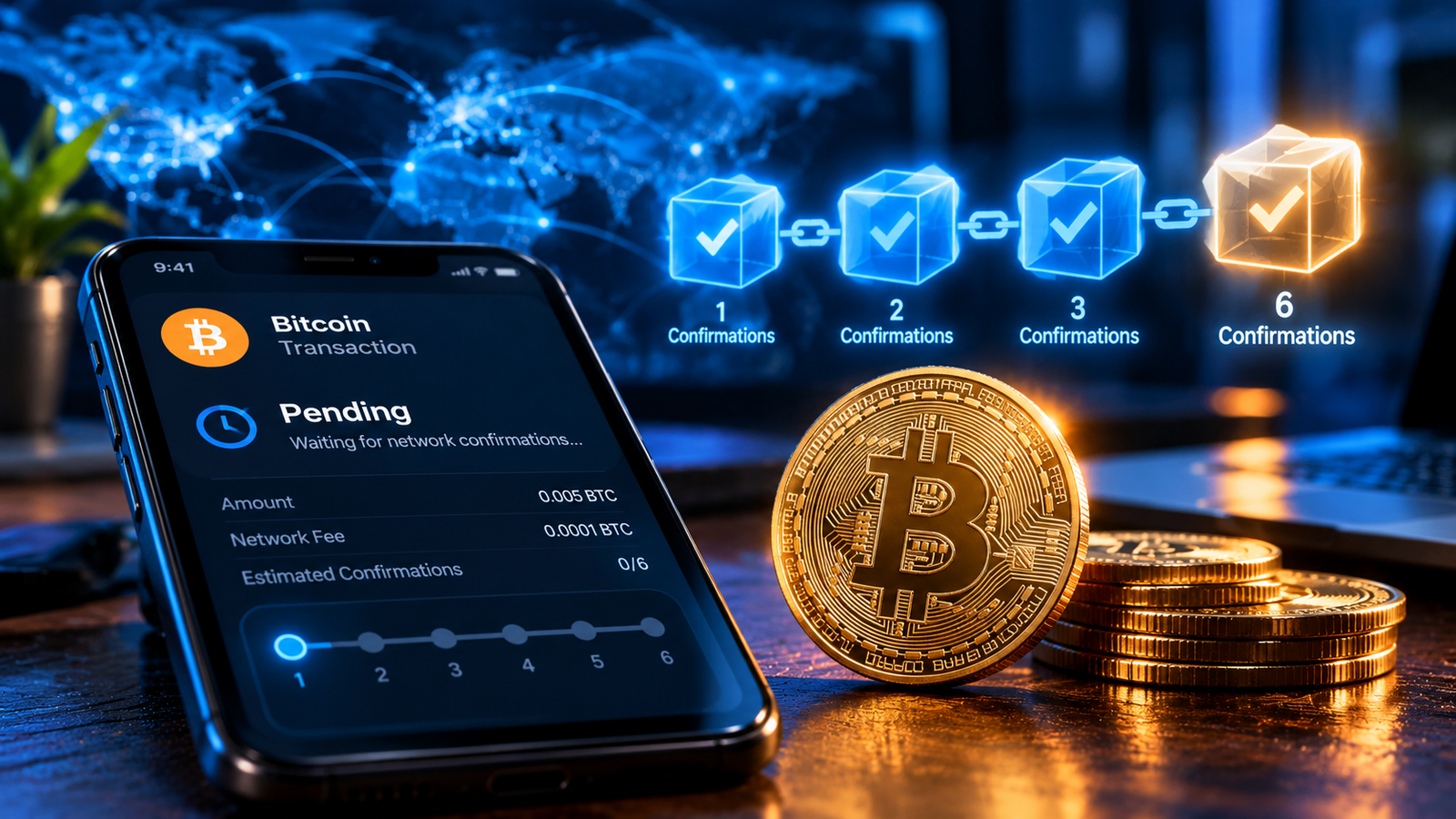
You send Bitcoin, your wallet shows the payment as sent, and the recipient says it has not arrived. The money seems to be caught somewhere in the network. In many cases, nothing has gone wrong: the transaction has been broadcast but has not yet been included in a block. Understanding that waiting period is one of the most useful Bitcoin skills a beginner can learn.
Broadcast is not confirmation
A Bitcoin wallet can create and broadcast a valid transaction to peers on the network. That is not the same as a miner including it in a block. While the transaction is unconfirmed, it may remain in a node’s memory pool, commonly called the mempool. The network has seen the proposed payment, but it has not yet been recorded in a block that forms part of the accepted chain.
Each block adds another layer
A transaction receives its first confirmation when it appears in a block. Each subsequent block built on top adds another confirmation. Reversing a transaction becomes more difficult as the chain grows, because an attacker would need to replace more accumulated proof-of-work. Confirmations therefore describe growing confidence, not an instant guarantee that every conceivable attack is impossible.
Why six confirmations became familiar
Bitcoin’s developer guidance describes six confirmations as a common high-confidence threshold for higher-value payments. It is not a universal rule for every purchase. A merchant selling a low-cost digital item may make a different risk decision from an institution receiving a large transfer. Different wallets and exchanges can impose their own deposit confirmation requirements.
Fees and congestion affect timing
Bitcoin targets a new block roughly every ten minutes on average, but individual intervals vary. Transactions compete for limited block space. Miners generally prefer transactions that offer more fees relative to their size. A low-fee transaction may wait longer when demand is high. That does not necessarily mean the coins have disappeared; the appropriate next step depends on the wallet and transaction status.
What to check before panicking
Start with the transaction ID, often called the TXID, and look it up using a reputable block explorer. Check whether it is unconfirmed or has appeared in a block, and verify the recipient address carefully. Avoid sending the same payment again without understanding the first transaction’s status. If an exchange is involved, remember its internal crediting policy may take longer than on-chain confirmation.
The bottom line
A sent transaction is not necessarily a confirmed transaction. Bitcoin confirmations provide a measurable way to understand how deeply a payment is recorded in the chain. Knowing the difference helps users interpret wallet notifications without treating every delay as a loss.
Sources
Educational information, not financial advice.

